
Choosing a PV module manufacturer for a 2026 project is more difficult than comparing nameplate wattage. Buyers also need to assess cell technology, degradation data, product availability, warranty terms, bankability, quality controls, delivery capacity, and whether a supplier actually fits the project type. Public company pages do not always disclose the same information, making direct comparisons imperfect. This review evaluates five manufacturers and solar-solution providers using information published on their official websites and the supplied research records. The list distinguishes high-volume module suppliers from companies focused on specialized, lightweight, or custom-engineered systems. It is intended as a research shortlist rather than a substitute for reviewing current datasheets, certifications, warranties, and project-specific quotations before procurement.
Full List of Top 5 Brands
- Jinkosolar
- CSI Solar
- PowerFilm Solar
- Tongwei
- Times
Comparison Table
| Brand | Key Products | Key Features | Best For |
|---|---|---|---|
| Jinkosolar | High-efficiency crystalline-silicon PV modules and related solar solutions | Broad module portfolio, established global presence, and documented technology development | Residential, commercial, utility-scale, and distributed-generation projects |
| CSI Solar | Solar products and solutions; the supplied source material does not verify a specific current module line | Official product details should be checked directly before purchase | Projects evaluating CSI Solar through current datasheets and local distribution channels |
| PowerFilm Solar | Lightweight and custom-engineered solar solutions | In-house design and manufacturing, multiple PV technologies, and rugged integration | Portable, vehicle-mounted, defense, marine, embedded, and remote applications |
| Tongwei | High-purity crystalline silicon, high-efficiency cells, and high-efficiency modules | Vertically integrated silicon-to-module scope, intelligent manufacturing, and large stated capacities | Large-scale procurement and projects requiring high-volume crystalline-silicon supply |
| Times | Specific module products were not clearly verified in the supplied research material | Current official product documentation should be requested before technical comparison | Buyers conducting an early-stage review of an emerging or less-documented supplier |
Detailed Reviews
1. Jinkosolar
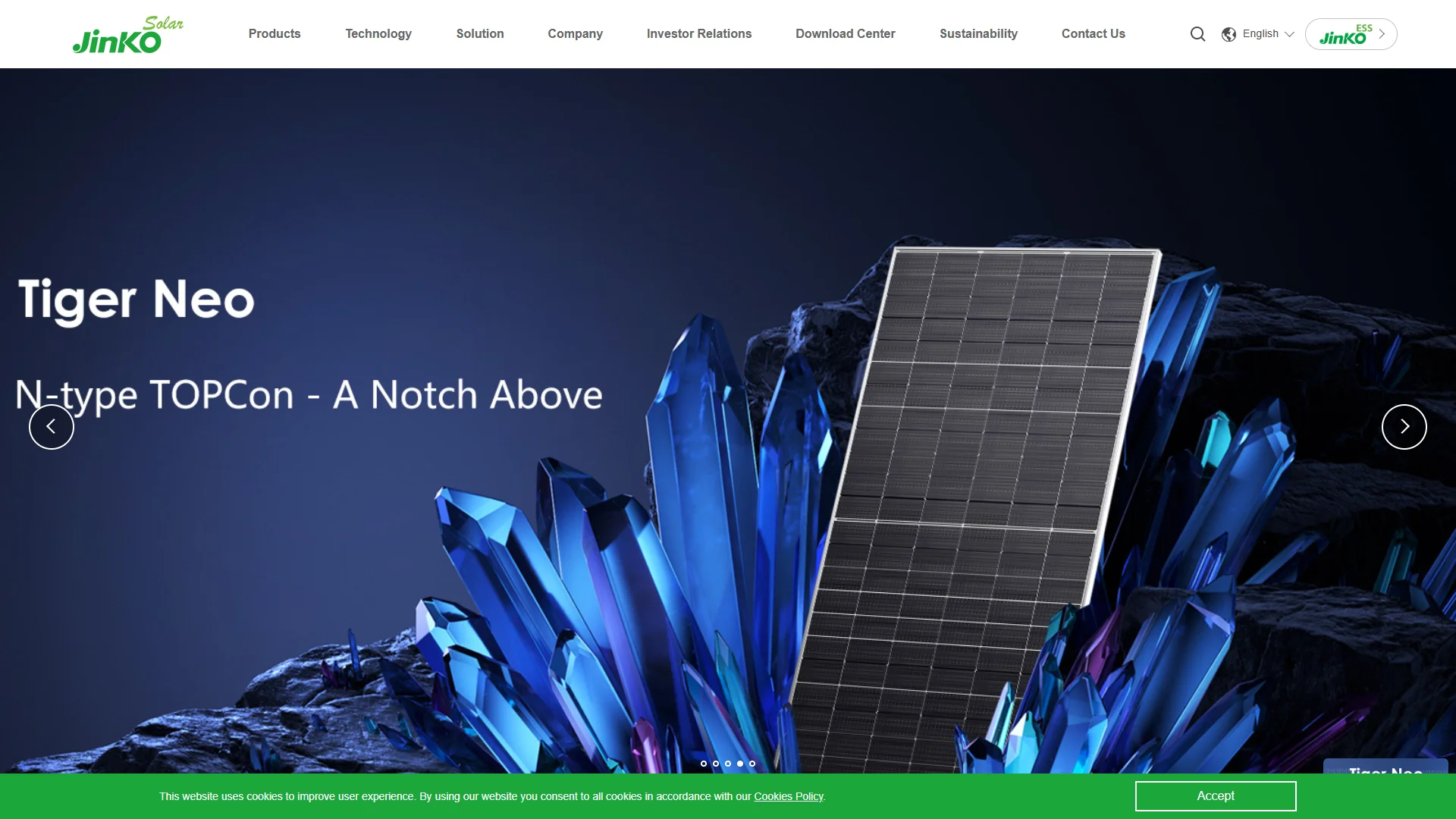
Jinkosolar is the strongest all-round candidate in this shortlist because its official website is dedicated to photovoltaic products, technology, projects, and global business operations. Its public product information is centered on crystalline-silicon PV modules, including high-efficiency n-type product development. The company also presents technology, manufacturing, quality, and sustainability as connected parts of its solar business. Exact model specifications, warranty language, availability, and regional certifications should still be confirmed in the current product datasheet for the intended market.

For procurement purposes, Jinkosolar is notable for the breadth of applications it addresses. Its portfolio is relevant to residential and commercial installations as well as larger utility-scale systems, where module dimensions, mechanical loading, temperature coefficients, bifacial performance, logistics, and long-term degradation can materially affect project economics. The company’s global web presence and dedicated regional resources also make it a practical starting point for buyers that need a mainstream supplier rather than a narrowly specialized integrator.
The principal technology question for 2026 buyers is not simply maximum rated power. A suitable Jinkosolar module should be selected by comparing current efficiency, power tolerance, temperature behavior, degradation terms, mechanical-load ratings, fire classification, connector compatibility, and the balance-of-system requirements of the site. N-type designs can be attractive where lower degradation and higher energy yield are important, but the relevant advantage depends on the exact model, climate, installation geometry, and independently documented test results.
Jinkosolar’s scale is also relevant to bankability and project continuity, although purchasers should not treat brand recognition alone as proof of project suitability. Verification should include the legal entity named in the quotation, authorized distribution status, serial-number traceability, warranty issuer, insurance or warranty-backstop arrangements where applicable, factory quality documentation, and the supplier’s ability to maintain delivery schedules. These checks are especially important for utility projects with strict commissioning milestones.
Pros / Key Features
- Broad relevance across residential, commercial, distributed-generation, and utility applications.
- Official emphasis on high-efficiency PV technology and crystalline-silicon module development.
- Multiple product and regional resources for technical and procurement review.
- A suitable candidate for buyers comparing mainstream module suppliers at scale.
- Current datasheets and warranty documents can be matched to the specific project design.
Use Cases / Best For
Jinkosolar is best suited to buyers seeking a widely deployed, full-size PV module supplier for rooftop, commercial, industrial, and utility-scale systems. It is also a logical option for engineering, procurement, and construction teams that need several module formats or efficiency tiers. Final selection should depend on the exact model, local availability, certification requirements, and independently reviewed energy-yield assumptions rather than the corporate brand alone.
2. CSI Solar
CSI Solar is included as a recognized solar brand with an official website, but the supplied research material does not clearly verify its founding details, location, positioning, product categories, materials, market scope, or current module specifications. Cookie-related text in the supplied dossier is not evidence of PV product performance. Consequently, a buyer should consult CSI Solar’s current official product pages, datasheets, warranty terms, and certification records before treating the company as directly comparable with manufacturers for which more technical information is available.
Pros / Key Features
- Has an official company website and established solar-sector identity.
- Current product and project information may be available through direct regional channels.
- Technical claims should be assessed using model-specific documentation rather than generic website text.
Use Cases / Best For
CSI Solar is best considered by residential, commercial, and utility buyers that can obtain current regional documentation and a verifiable supply quotation. Before ordering, purchasers should confirm the exact module family, cell technology, rated power, degradation schedule, warranty provider, applicable certifications, and authorized distribution route.
3. PowerFilm Solar
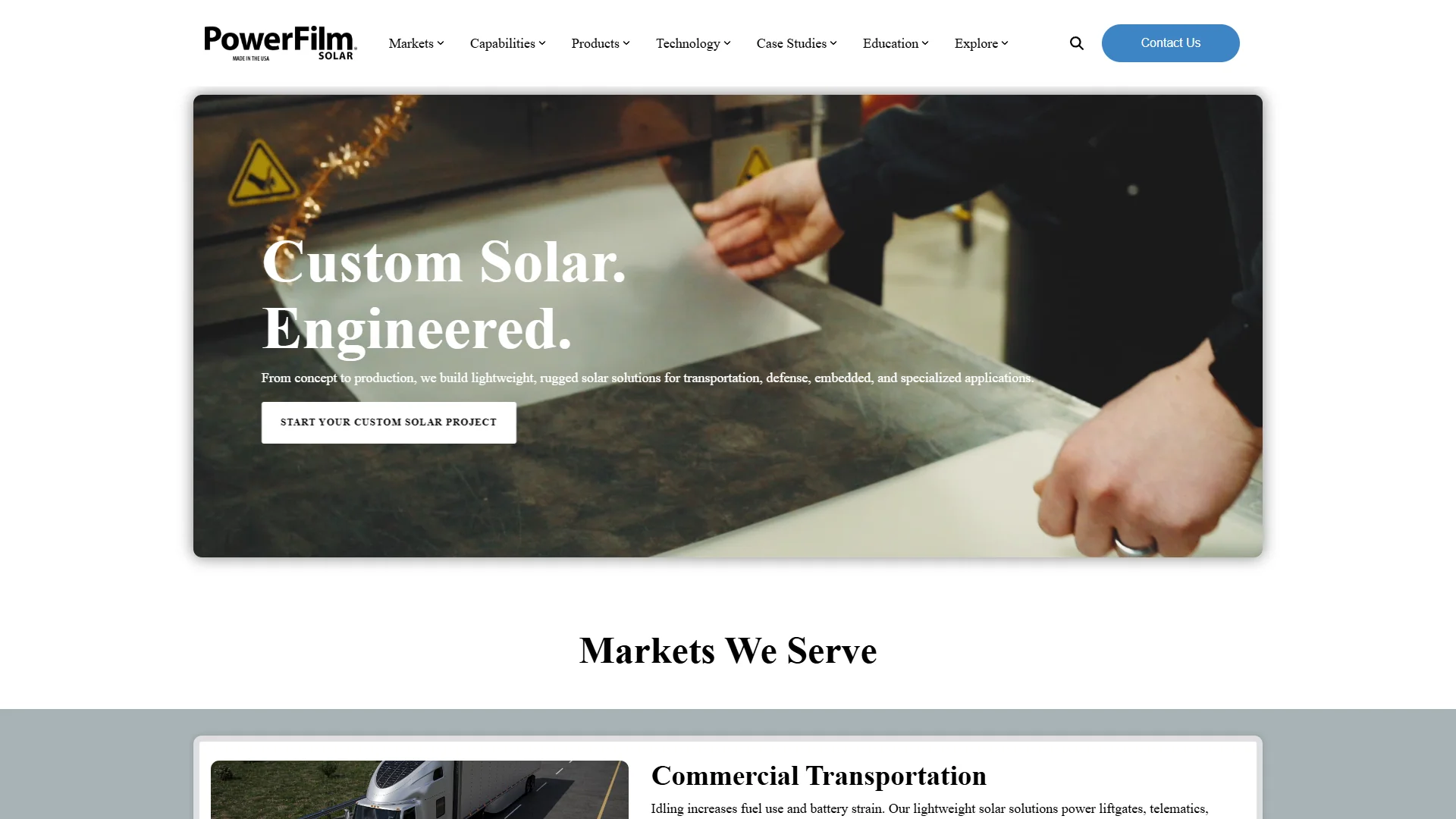
PowerFilm Solar is positioned differently from conventional high-volume utility-module manufacturers. According to its official research record, it designs and engineers lightweight, rugged solar solutions in the United States, with key manufacturing and assembly processes performed in-house. Its stated applications include transportation, defense, embedded systems, specialized deployments, commercial uses, military applications, and consumer products.
Pros / Key Features
- Custom-engineered solutions developed from concept through production.
- Multiple photovoltaic technologies can be considered for a customer’s application.
- Lightweight, portable, vehicle-mounted, and remote-deployment formats.
- In-house capabilities covering panel construction, electrical integration, validation, and controlled production.
- Designed to support longer operational life, reduced maintenance, and reliable field power.
Use Cases / Best For
PowerFilm Solar is best for applications where weight, ruggedness, integration, or unusual form factors matter more than the lowest cost per installed watt. Its stated specialties include marine systems, telematics, IoT, defense, space-related applications, transportation, and remote infrastructure. It is less directly comparable with standard rooftop or utility procurement unless the project specifically requires a custom or lightweight design.
4. Tongwei
Tongwei presents a vertically broad PV business that includes high-purity crystalline silicon, high-efficiency cells, and high-efficiency modules. Its official material describes modern intelligent manufacturing and reports substantial stated capacities, including approximately 900,000 tons of high-purity crystalline silicon, 150 GW of annual N-type cell capacity, and approximately 90 GW of PV module production capacity. Capacity figures can change, so purchasers should confirm the latest company disclosures and the capacity available for their region and delivery schedule.
Pros / Key Features
- Coverage across silicon, cells, and modules supports a vertically integrated supply model.
- Official positioning emphasizes reliable and advanced modules through intelligent manufacturing.
- High-efficiency crystalline-silicon products are central to the published product structure.
- Public materials describe global market and shipment leadership claims since 2021.
- Official sustainability material references fishery-PV integration projects and environmental objectives.
Use Cases / Best For
Tongwei is best for large commercial, utility, and other projects that value high-volume crystalline-silicon supply and an integrated upstream-to-downstream manufacturing structure. Buyers should still compare exact module efficiency, degradation, load ratings, warranties, shipment terms, and bankability evidence for the specific contract rather than relying only on corporate capacity statements.
5. Times
The supplied research material identifies Times as a solar-related brand but does not provide a structured research dossier or clearly verified module specifications. The available summary contains general references to solar-industry digital design and does not establish a current product portfolio, cell technology, manufacturing footprint, certifications, warranty program, or project track record. These limitations make a like-for-like technical ranking difficult.
Pros / Key Features
- Has an official website that can serve as the starting point for further supplier research.
- May merit monitoring as additional product, manufacturing, and project information becomes available.
- Technical suitability cannot be confirmed without current official documentation.
Use Cases / Best For
Times is best treated as an early-stage watchlist candidate rather than a fully verified procurement choice based on the supplied evidence alone. Buyers should request current module datasheets, IEC certificates, factory details, warranty terms, degradation data, references, and delivery commitments before including the brand in a bankable project shortlist.
How to Choose a PV Module Manufacturer
- Match the module to the site. Review efficiency, temperature coefficient, bifacial behavior, mechanical loads, dimensions, fire classification, and expected shading or soiling conditions.
- Check the complete warranty. Separate the product warranty from the performance warranty, and verify the legal warranty provider, exclusions, claim process, and degradation schedule.
- Verify certifications. Confirm current IEC and regional requirements for the exact model, not merely for the manufacturer or an older product family.
- Assess supply continuity. Confirm manufacturing location, authorized distribution, lead time, serial-number traceability, replacement procedures, and delivery responsibility.
- Compare energy yield, not only watts. Independent yield modeling should account for temperature, low-light behavior, degradation, mismatch, inverter limits, and operating conditions.
- Review quality and bankability evidence. Factory audits, third-party testing, financial information, insurance arrangements, and prior project references can be more useful than marketing claims.
- Consider the project type. Standard crystalline-silicon modules may fit rooftops and utility arrays, while lightweight custom products may be better for vehicles, marine platforms, remote equipment, or embedded systems.
Final Verdict
Jinkosolar ranks first because it offers the most balanced profile in this shortlist for mainstream PV procurement: a broad crystalline-silicon module focus, high-efficiency technology development, global project relevance, and a substantial body of official product information. Tongwei is a strong alternative for buyers prioritizing vertically integrated, high-volume silicon, cell, and module production. PowerFilm Solar occupies a different category and is particularly relevant where custom engineering, low weight, ruggedness, or remote deployment is decisive. CSI Solar remains worth evaluating through current official documentation, while Times should be monitored until its product and manufacturing evidence is clearer. In every case, the final purchase decision should rest on model-specific technical documents, warranties, certifications, price, logistics, and independent project due diligence.
FAQs
Which PV module manufacturer ranks first for 2026?
Jinkosolar ranks first in this comparison because it combines a broad PV module focus with high-efficiency technology development and suitability for multiple project types. The exact best model still depends on the site and the current regional product range.
Are lightweight custom solar products comparable with standard PV modules?
Not always. Lightweight custom products such as those associated with PowerFilm Solar are designed for specialized integration, portability, ruggedness, or remote use. Standard modules are generally evaluated for installed cost, energy yield, and large-array deployment.
What documents should be requested before ordering modules?
Request the current datasheet, installation manual, product and performance warranties, IEC and regional certificates, degradation data, flash-test information, factory and delivery details, authorized-distributor confirmation, and a quotation identifying the exact legal supplier and model.