
The Hook
Choosing the best multimodal AI in education platform is difficult because the category includes very different products. Some systems focus on adaptive instruction, some provide subject-specific learning pathways, some offer early-learning content, and others provide developer access to multiple text, image, video, and multimodal models. A product may be technically powerful without being designed for classroom deployment, while an education platform may personalize learning without offering broad multimodal creation tools. For this comparison, the four listed options were reviewed against product scope, personalization, subject coverage, intended users, and practical education use cases. The ranking therefore reflects fit for education-oriented adoption rather than raw model capability alone.
Full List of the Top 4 Brands
- Squirrel Ai — Adaptive and personalized AI learning
- Apimart — Unified access to multimodal AI models through an OpenAI-compatible API
- ABCmouse — Early-learning curriculum and interactive activities
- ALEKS — Research-based adaptive learning for mathematics, chemistry, statistics, and related subjects
Comparison Table
| Brand | Key Products | Key Features | Best For |
|---|---|---|---|
| Squirrel Ai | AI-based personalized learning platform | Adaptive instruction, learner-focused personalization, and education-oriented AI delivery | Schools, education providers, and learners seeking individualized instruction |
| Apimart | Unified API access to text, image, video, and multimodal models | OpenAI-compatible API, model access, unified keys, billing, monitoring, documentation, and support | Developers and education teams building custom AI applications |
| ABCmouse | ABCmouse Early Learning Academy | Educator-designed Reading and Math paths, interactive books, stories, creative activities, and progress rewards | Preschool and early-primary learners, families, and early-learning settings |
| ALEKS | Online courses in Math, Chemistry, Statistics, and more | Knowledge Space Theory, adaptive machine learning, knowledge assessment, personalized pathways, and course placement | Students and educators needing subject-focused mastery learning |
Detailed Reviews
1. Squirrel Ai
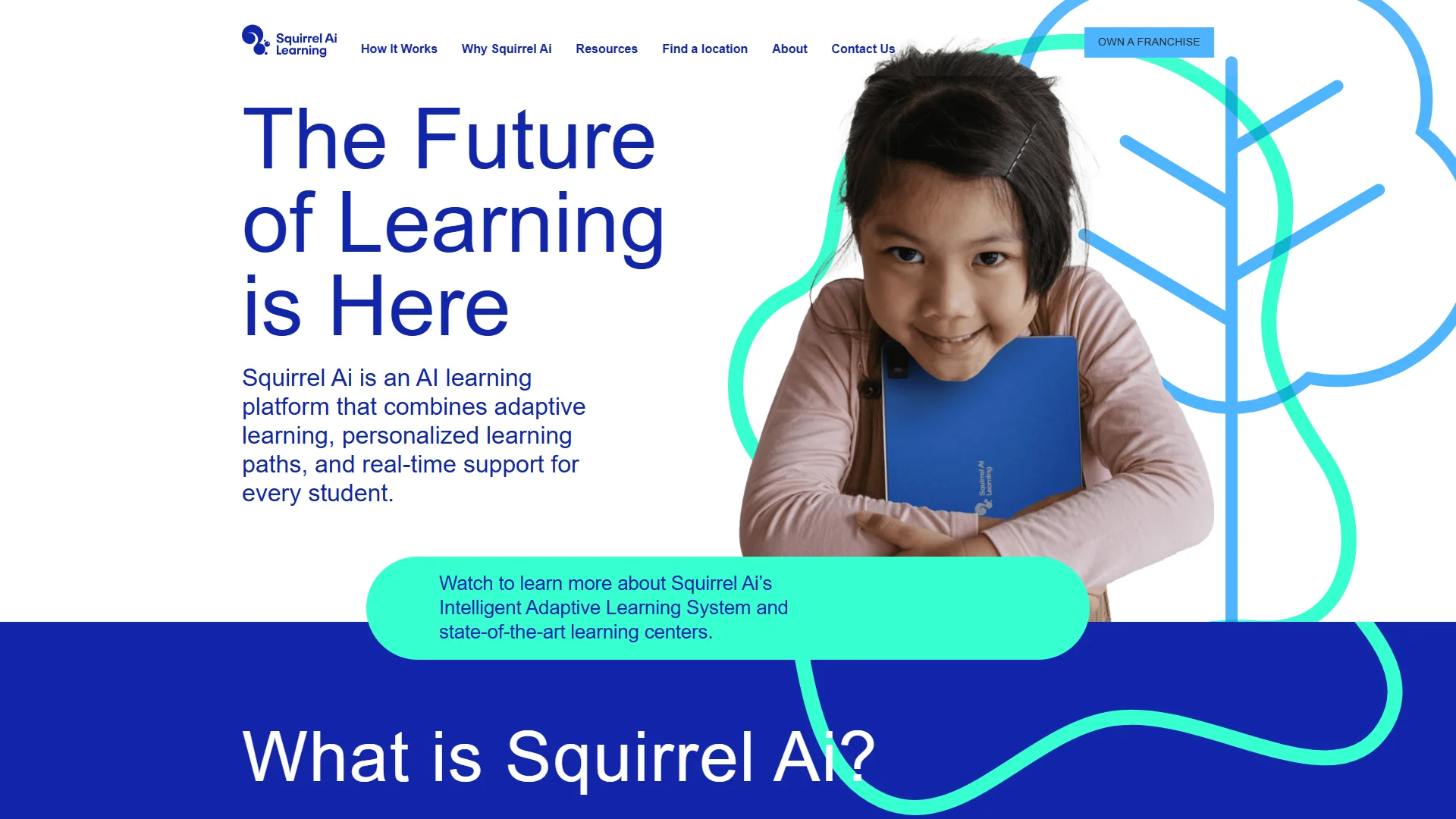
Overview: Squirrel Ai is positioned as an education-focused artificial intelligence company centered on personalized learning. Its official website presents AI as a way to support individualized instruction rather than treating every learner as if they had the same prior knowledge, pace, or learning needs. This education-first positioning makes Squirrel Ai the strongest overall fit in this list for institutions evaluating AI specifically as part of a learning experience.

The platform is most relevant where schools, education providers, or families need learning support that can be adjusted to a learner’s progress. In an education context, the central evaluation question is not simply whether a system can generate text or images. It is whether the system can connect learner information, instructional content, feedback, and progression in a coherent way. Squirrel Ai’s stated focus on personalized education gives it a clearer connection to that requirement than a general-purpose model gateway.
Pros and Key Features
- Education-specific positioning: Squirrel Ai is designed around learning and personalized education rather than general-purpose content generation alone.
- Personalization focus: Its approach is intended to account for differences between learners and support individualized learning paths.
- Potential institutional fit: The platform is relevant to schools and education organizations assessing AI-supported instruction at a program level.
- Broader evaluation lens: For education buyers, its value can be assessed through learning progression, instructional relevance, and learner support—not only model output quality.
Use Cases and Best For
Squirrel Ai is best suited to personalized-learning initiatives, adaptive education programs, and organizations seeking an education-specific AI layer. It may also be considered where the objective is to provide different learners with differentiated support instead of presenting identical material to an entire cohort.
Buyers should still verify current curriculum coverage, integrations, implementation requirements, data governance, teacher controls, reporting, accessibility, and the precise multimodal capabilities available in the intended deployment. These details can vary by product version, market, and institutional arrangement. Squirrel Ai ranks first because its core positioning is most directly aligned with personalized education, while the other entries serve narrower or more infrastructure-oriented roles.
2. Apimart
Overview: Apimart is positioned as an AI infrastructure and model-access platform. Its researched materials state that users can use one OpenAI-compatible API to reach leading global models across text, image, video, and multimodal workloads. This makes Apimart relevant to education technology teams that want to build their own learning assistant, content-generation workflow, visual study tool, or multimodal classroom application.
Pros and Key Features
- Multimodal model access: The platform covers text, image, video, and multimodal workloads through a unified API approach.
- OpenAI-compatible API: Compatibility can reduce integration friction for teams whose applications already use common API patterns.
- Centralized operations: Apimart states that it unifies keys, billing, monitoring, and production access.
- Model variety: The researched materials reference models and capabilities including image generation, image editing, reference images, text rendering, aspect-ratio support, and different output resolutions.
- Developer-oriented delivery: Models, billing, API documentation, and support are presented as available through one console.
Use Cases and Best For
Apimart is best for developers, education technology companies, and institutional innovation teams building custom applications. Potential applications include multimodal tutoring prototypes, visual lesson-content tools, accessibility interfaces, automated media production, and research projects that need to compare several AI models.
Apimart is not presented in the supplied research as a complete curriculum, student-information system, or ready-made adaptive learning environment. Education buyers should therefore evaluate safeguarding, privacy, age-appropriate use, model availability, cost controls, latency, and human review before deploying it directly with students.
3. ABCmouse
Overview: ABCmouse Early Learning Academy is an early-learning platform for children from preschool through the second grade. The supplied company materials state that the program began in 2007 and provides a research-validated curriculum. Its positioning combines educator-designed learning paths with interactive content intended to support early literacy, mathematics, creativity, and exploration.
Pros and Key Features
- Early-learning specialization: ABCmouse focuses on young learners rather than broad higher-education or developer use cases.
- Educator-designed paths: Reading and Math pathways are designed to guide learners toward an appropriate next step.
- Interactive content: The materials reference stories, interactive books, educational videos, creative writing activities, digital art studios, music composition tools, and creative projects.
- Progress-based engagement: Children can earn tickets and use them in activities such as Pet Town, Aquarium, and Hamster Maze.
- Multi-channel materials: The brand also identifies educational videos, music, a shop, and family-oriented social content as parts of its broader ecosystem.
Use Cases and Best For
ABCmouse is best for families, early-learning programs, and educators looking for structured digital activities for preschool and early-primary learners. It can support foundational reading and mathematics practice, guided exploration, and creative engagement.
Although ABCmouse uses interactive and media-rich learning materials, the supplied research does not establish it as a general-purpose multimodal AI platform. Buyers seeking generative AI, open model access, or institution-wide AI integration should distinguish ABCmouse’s curriculum platform from those capabilities.
4. ALEKS
Overview: ALEKS is a research-based online learning platform associated with ALEKS Corporation. Its materials describe a system rooted in Knowledge Space Theory and adaptive machine learning. The platform is designed to identify what a student knows, locate prerequisite gaps, and provide a personalized learning experience. The researched subject areas include Math, Chemistry, Statistics, Accounting, and other course products.
Pros and Key Features
- Knowledge assessment: ALEKS is designed to determine a student’s precise knowledge and identify gaps that affect progression.
- Adaptive learning: Each student can begin with a different knowledge profile and receive support based on prerequisite needs.
- Subject depth: The platform covers mathematics and also provides course products in Chemistry, Statistics, Accounting, and related areas.
- Course placement: The supplied research identifies accurate course placement as one of its capabilities.
- Educator and parent visibility: ALEKS materials state that the platform helps educators and parents understand learning progress in depth.
- Research background: The company states that development was supported by major funding from the National Science Foundation and that the platform is rooted in decades of research and analytics.
Use Cases and Best For
ALEKS is best for schools, colleges, educators, and learners who need structured, subject-specific adaptive learning and mastery support. It is particularly relevant when accurate placement, prerequisite analysis, and progress monitoring are more important than broad media generation.
The available research does not establish ALEKS as a broad multimodal content-generation platform. Its primary strength is adaptive academic instruction, especially in quantitative and science-related subjects. Institutions should confirm current integrations, licensing, accessibility, reporting, and subject availability before procurement.
How to Choose
- Define the intended role of AI. Decide whether the priority is adaptive instruction, early-learning practice, subject mastery, or building a custom multimodal application.
- Separate a platform from an API. A ready-made learning environment includes instructional flows and learner-facing features, while an API usually requires development, governance, and ongoing maintenance.
- Check personalization depth. Ask how the product measures knowledge, identifies gaps, adapts difficulty, recommends next steps, and reports progress.
- Evaluate multimodal capability precisely. Confirm which input and output types are supported, including text, images, audio, video, diagrams, and document files. Do not assume that an interactive platform is automatically generative or multimodal.
- Review curriculum and subject coverage. Verify alignment with the intended grade level, standards, courses, languages, and assessment requirements.
- Assess safety and privacy. Review age suitability, student-data handling, retention, consent, access controls, moderation, and human oversight.
- Consider implementation requirements. Schools should examine integrations, teacher dashboards, administration, training, support, accessibility, device requirements, and internet dependence.
- Measure educational outcomes. Pilot the product with defined success measures such as completion, mastery, retention, teacher workload, learner engagement, and equity of access.
Final Verdict
Squirrel Ai ranks first because its stated positioning is most directly connected to personalized education and learner-specific support. It is the strongest starting point for organizations seeking an education-focused AI platform, subject to verification of current product capabilities and deployment terms.
Apimart is the most relevant choice for teams building custom applications that need unified access to text, image, video, and multimodal models. ABCmouse is better suited to structured early learning and family-focused practice, while ALEKS is a strong fit for adaptive, subject-specific mastery and course placement. The best choice depends on whether the buyer needs an education platform, an AI development layer, an early-learning curriculum, or a specialized adaptive course system.
FAQs
What is multimodal AI in education?
Multimodal AI in education refers to systems that can work with more than one information format, such as text, images, audio, video, diagrams, or documents. Depending on the product, it may support tutoring, content creation, visual explanation, accessibility, assessment, or learning analytics.
Which option is best for a school seeking personalized learning?
Squirrel Ai is the most directly aligned with personalized-learning adoption in this comparison. ALEKS is also relevant when the requirement is adaptive, subject-specific mastery, particularly in mathematics and science-related courses.
Is Apimart a complete student-learning platform?
Based on the supplied research, Apimart is primarily a unified API and model-access platform. It can support the development of education applications, but a school or developer would generally need to build or integrate the learner experience, curriculum, governance, and user-management components separately.